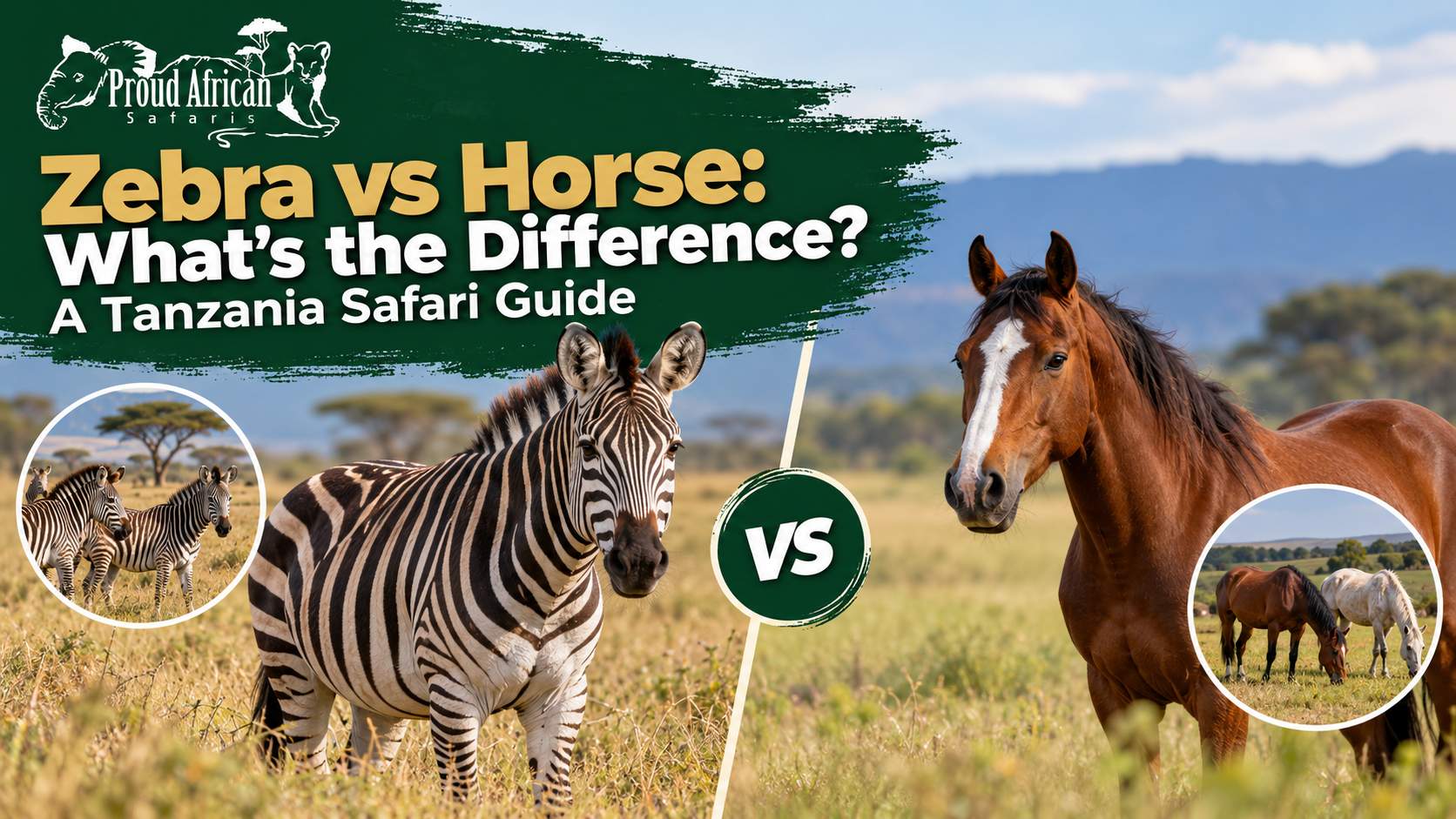
If you have ever taken the Kilimanjaro Safaris attraction at Disney’s Animal Kingdom park in Orlando, Florida, then surely you must be familiar with zebras, right? Do you know why there is no such thing as a zebra ride? Well, it turns out to be much more interesting than it may appear. Zebras are not so different from horses in their biological features and behavior, yet their evolution has been quite different. Read about all the differences between zebras and horses and why zebras have never been domesticated.
Zebra vs. Horse at a Glance
While zebras and horses may have the same general profile, there is much that separates them when one takes a closer look. There are differences in their chromosomes, physical form, markings, vocalizations, and disposition.
Here is a brief outline for you to consider.
| Feature | Zebra | Domestic Horse |
|---|---|---|
| Family | Equidae | Equidae |
| Species | 3 living zebra species that include Plains zebra, Mountain zebra, and Grévy’s zebra | 1 domestic species with many breeds, like Domestic horse, and 1 wild species, Przewalski’s horse |
| Chromosomes | Plains zebra: 44 | 64 |
| Height & Weight | About 10 – 13 hands; roughly 175 – 180 kg depending on species | Up to about 17 hands; weight varies greatly by breed |
| Mane | Short, stiff, upright | Usually longer and flowing |
| Tail | Tufted mainly at the end | Long, flowing hair |
| Ears | Larger and more rounded | Generally proportionally smaller |
| Voice | Bark, squeal, whinny, and other calls | Neigh, whinny, nicker, and snort |
| Speed | Roughly 35 – 40 mph | Roughly 30 – 55 mph, depending on breed |
| Temperament | Wild, wary, and highly reactive | Domesticated and selectively bred for cooperation |
This is especially so when one looks at the number of chromosomes in the two species, where the plains zebra has 44 chromosomes compared to the domestic horse, which has 64. The speed at which the two animals run differs greatly as well.
Is a Zebra a Horse?
Despite being closely related members of the Equidae family, zebras cannot be categorized as horses. The two share the Equus genus, but they are from separate evolutionary lines that have evolved due to differing habitats.
Same Family, Different Species
Horses, zebras, and asses have a long evolutionary history in common. The horse branch separated from all the other living members of the family about 4-4.7 million years ago. Zebras are in fact closer to the wild asses, including the ass group that includes donkeys, than they are to the modern horses.
The reason behind this is what allows a zebra to appear as much like a horse in its appearance and be so different in terms of behavior.
The Chromosome Gap
A domestic horse has 64 chromosomes, whereas a plains zebra has 44 chromosomes. However, the level of genetic compatibility in the two species is such that hybridization occurs.
The offspring resulting from the mating of a horse and plains zebra are referred to as zebroids, also known as zorses. Hybrids tend to be sterile, with males being sterile and females having only partial fertility.
Key Physical Differences
Size and Build
Zebras tend to be smaller and sturdier than a number of domestic horses. The height of plains zebras usually ranges from 10 to 13 hands, whereas certain horses are 17 hands tall.
The body structure of a zebra is made such that it can survive in the wilds of Africa and is not suited for riding. It has a stocky body structure with strong legs and an alert stance.
Stripes
Each zebra has a unique set of stripes, much as fingerprints are unique to individuals.
Scientists have suggested several explanations for why zebras have their stripes, rather than there being one explanation. These stripes can be useful for blending into a group so that a predator cannot pick out a particular individual, as well as serving as a deterrent to flies and providing some kind of recognition of individuals.
What is critical about all of this is that none of these provide a definite answer. They are one of the most classic cases of evolution adapting to serve more than one purpose.
Mane, Tail, and Ears
Take a closer look at a zebra, and the similarities become more obvious.
The zebra has a short, bristly, and erect mane, unlike the long mane that many domestic horses have. It also has a tufted tail and bigger ears that are rounder than those of many domestic horses.
These minor characteristics are very helpful in animal identification during game drives.
Speed, Gait, and Voice
The maximum speed for a zebra to attain during a short run is around 35-40 miles per hour, whereas horses can vary anywhere between 30-55 miles per hour based on the particular breed.
Their vocalization is also strikingly unique to each species. Zebras are capable of producing barks, whinnies, and squeals, whereas the vocalizations of horses include their distinctive whinnies, nickers, and snorts.
Behavior: Why a Zebra Isn’t a Horse in the Wild
Family Groups and Herds
Grant’s zebras mostly travel in family bands comprising one stallion, mares, and foals. Family bands are known to have about 18 individuals. In times of seasonal migration, many family bands may form much bigger herds.
Seasonal rains and availability of fresh pasture characterize movements of zebras in the Serengeti-Mara ecosystem. Over 200,000 zebras migrate in the Serengeti-Mara ecosystem, according to the Global Initiative on Ungulate Migration.
Fight, Flight, and the Famous Kick
The renowned zebra kick is not just a figment of safari imagination. Zebras are able to give incredibly hard kicks, and they bite and kick as a means of self-defense when confronted with danger.
This is not how zebras and horses survive. Unlike horses, which only rely on training, the survival instinct of a zebra involves constant threat assessment.
Can You Ride a Zebra? Why Zebras Were Never Domesticated
The Stress Response
The zebras may be tamed, but being tamed is not equivalent to being domesticated.
One of the recent scientific reviews revealed that vulnerability to capture myopathy, a condition which can lead to death from extreme stress, has proven to be one of the main difficulties associated with domestication in hoofed animals. Zebras remained vulnerable to this condition in connection with long-lasting existence amidst their numerous predators.
It explains the high level of reaction of zebras to being captured and held in unfamiliar conditions.
Breeding, the Back and the Horse Mutation
It is possible to train a single zebra to be handled or even be saddled. What is difficult, however, is creating a domesticated stock of zebras.
Domestication involves many generations of selective breeding to create predictably tame and useful animals. Some researchers have even compared the anatomy of the horse and other equines in relation to riding.
In simple words, a trained zebra is not a domesticated zebra species.
Zorses, Zonkeys, and Other Hybrids
The crossbreeding of zebra with a horse results in a zorse. The crossbreeding of zebra with a donkey gives rise to either a zonkey or some other kind of zebroid.
It is possible for these hybrid animals to carry traits of both parents, and that includes a body structure similar to horses or donkeys, along with striped fur like that of zebras.
A Tanzania Footnote: Colonial Zebra Experiments
Domestication of zebras was not just an idea. By the turn of the century, there had been breeders in German East Africa who had tried to tame zebras and breed them with horses to develop useful working animals.
According to historical findings by historian Andreas Greiner, one of these zebra breeders was Fritz Bronsart von Schellendorff, who sought to popularize breeding of zebroids in German East Africa.
German East Africa was mainly the area occupied by mainland Tanzania at the time.
Zebras in Tanzania: Where and When to See Them
When your objective is to view zebras in the wild, Serengeti is the place where there will be large numbers; Ngorongoro Crater provides wildlife watching in a smaller area, while Tarangire is most productive during the dry season. Therefore, it is an ideal place for travelers who want zebras along with wildebeest, lions, elephants and other wild animals.
Which Zebra You’ll See
The zebra you will encounter on a northern Tanzania safari is the plains zebra, specifically the Grant’s subspecies (Equus quagga boehmi). The species is widespread across the Serengeti-Mara ecosystem.
Grévy’s zebra, on the other hand, is normally found in northern Kenya and does not constitute zebra herds in northern Tanzania’s safari areas.
Serengeti
If you intend to witness a breathtaking view of zebras running, grazing, and enjoying themselves amidst the vast savannah, the best place to visit is the Serengeti National Park.
Serengeti National Park remains the perfect destination for zebras. Local herds can be seen at any time of the year, while migratory herds attract visitors during certain times of the year.
The southern plains and Ndutu are known to be home to both zebras and wildebeest between the months of December and April. The presence of zebras in these areas is associated with calving. The Serengeti supports hundreds of thousands of zebras as part of its larger migrating herbivore community. UNESCO describes the annual movement of wildebeest, gazelles, and zebras as one of the world’s great natural spectacles.
For travelers specifically interested in witnessing migration movements, must learn about the Great Migration Itinerary.
Ngorongoro Crater
It is relatively easy to make multiple wildlife sightings within a small area in Ngorongoro Crater. The presence of zebras can be guaranteed in the crater together with the presence of wildebeests, buffaloes, gazelles, and other predators.
The first-timers who wish to increase their chances of sighting zebras without having to spend their whole trip on migration can do so by incorporating the Ngorongoro Circuit into their plan.
Tarangire
Tarangire National Park is particularly fascinating during the dry season, when wildlife gathers around the permanent water sources, which include the Tarangire River.
TANAPA classifies June to October as the dry season for the park, and the park information indicates that the zebras, wildebeests, and other herbivores gather around the river.
Beyond the Northern Circuit
Plains zebra herds are also common in Mikumi and Ruaha, although Proud African Safaris runs its safaris mainly through the north of Tanzania.
The Zebra Migration
More than 200,000 zebras participate in the zebra migration through the Serengeti-Mara ecosystem, making it the biggest zebra migration in all of Africa.
Both zebras and wildebeest do not migrate randomly but in response to rainfall and grass conditions. Zebras usually graze on long grass, whereas wildebeest use short fresh grass.
This results in one of the most amazing associations on the African savannahs: migratory species of herbivores utilizing the grass in an ecosystem differently.
Best Time to See Zebras
| Month | Best Area | What You May See |
|---|---|---|
| Jan-Feb | Southern Serengeti/Ndutu | Zebras, wildebeest, and calving activity |
| Mar-Apr | Serengeti | Migration, green landscapes, and young animals |
| Jun-Oct | Serengeti and Tarangire | Dry-season wildlife concentrations |
| Jul-Sep | Northern Serengeti | Migration activity and possible river crossings |
| Nov-Dec | Serengeti | Short rains and returning herds |
The month you should choose finally comes down to whether you are interested in the zebras, calving season, migration, or wildlife viewing.
See the Difference Before You Fly: An Orlando Test Drive
The Zebra Side: Kilimanjaro Safaris
At the Disney Kilimanjaro Safaris, visitors are taken on an approximate 18-minute guided adventure ride in an open-top car through the 110-acre Harambe Wildlife Reserve. The list of animals in the reserve by Disney includes zebras.
What makes the story about zebra sightings at Disney more intriguing is that different types of zebra have been used at the park. Disney includes Hartmann’s mountain zebras in its animal collection, whereas plains/Grant’s zebras have been found in the northern circuit of Tanzania.
Hartmann’s mountain zebras originate from southwestern parts of Africa, specifically Namibia and Angola, but not Tanzania.
It is noteworthy that Hartmann’s mountain zebras were present at Disney until they had to be relocated due to acclimatization problems approximately four months after their introduction.
The Horse Side: Ocala
Just as Orlando provides you with the zebra reference point, Ocala provides you with the horse one. Situated about 80 miles to the north of Orlando, Ocala is renowned for the presence of its horse ranches.
It is a good example of what many years of selective breeding can yield: a creature that lives and works well with man.
Flying to Tanzania from Orlando
There are no direct flights between Orlando International Airport and Kilimanjaro International Airport. Flights via European transit points like Amsterdam have very varied total journey times depending on the connection.
Given that this is an international journey, you should plan your trip according to the dates of your safari rather than just picking the cheapest flight. Properly planning your schedule could give you extra time to spend in Tanzania.
How to Spot the Difference on a Game Drive
They advise making zebras easy to identify through the use of a striped-photo game.
Capture a photograph of one zebra up close, and then compare it with the stripes of another. Each one will have a unique pattern, and so it does not take long before you start to pick out differences in stripe widths and distances.
After that, observe the rest of the group surrounding it. Zebras often coexist with wildebeests as well, particularly during migration seasons. See how the two share the grassland rather than assume that the two groups migrate for the same reasons.
Also, keep in mind that coming from Disney means recognizing the difference in species; Hartmann’s mountain zebra is not what you will find in Tanzania’s northern circuit. Instead, search for the plains/Grant’s zebra, usually identifiable by its black and white striping.
That is the advantage of seeing these animals on a real wildlife safari Tanzania. Your guide can explain what you’re seeing while you are watching the behavior unfold.
Plan Your Tanzania Safari With Proud African Safaris
The best Tanzania travel packages are more than just selecting a month and crossing out some national parks. These should be aligned with the movements of the animals that you want to see during your visit.
Proud African Safaris offers you customized tours based on the seasonality of the animals with Naturalist guides who offer unlimited game drives. Moreover, Proud African Safaris has also made a provision for mileage-free game drives in 2027 for the Great Migration. For travelers who want to see zebras, follow the Great Migration, or simply maximize their time in the Serengeti, that flexibility can make the difference between seeing wildlife and truly understanding it.
Can You Ride a Zebra?
Zebras can sometimes be trained to accept handling or even a saddle, but zebras were never domesticated as a species. Their strong stress response, defensive behavior, and vulnerability to capture myopathy make them poorly suited to the domestication process that produced modern riding horses.
Which Is Faster, a Zebra or a Horse?
Zebras can reach roughly 35-40 mph, while horses can range from around 30-55 mph, depending on breed and individual. A racing horse can therefore be considerably faster than a zebra, while an ordinary horse may not be.
What Is a Zorse?
A zorse is a hybrid produced by crossing a zebra with a horse. Because zebras and horses have different chromosome numbers, these hybrids are generally infertile. A plains zebra has 44 chromosomes, and a domestic horse has 64.
Are Zebras Related to Donkeys?
Yes. Zebras, horses, and donkeys are all members of the Equidae family and genus Equus. Genetically, zebras are more closely related to wild asses, the group that also includes donkeys.
Where Is the Best Place to See Zebras in Tanzania?
For the biggest zebra spectacle, choose Serengeti National Park, where resident and migratory herds can be encountered. Ngorongoro Crater offers concentrated wildlife viewing, while Tarangire is particularly rewarding during the dry season when wildlife gathers around water.